


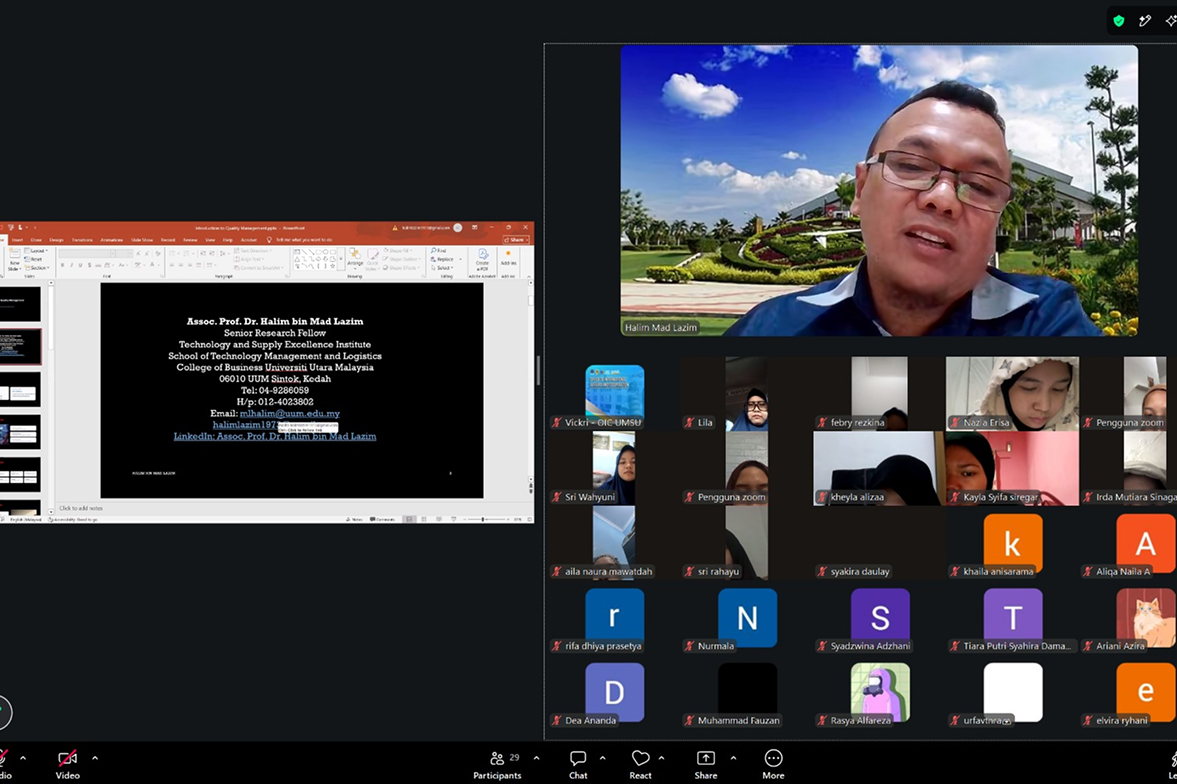

Faculty of Economics and Business, Universitas Muhammadiyah Sumatera Utara (FEB UMSU) successfully hosted an international webinar titled “Introduction to Quality Management: Core Frameworks, Manufacturing Precision, and Service Excellence Across Modern Operations” via the Zoom platform at 08:30 AM WIB. The virtual event was directly attended by Assoc. Prof. Dr. Lila Bismala, S.T., M.Si. alongside academic faculty members, featuring Assoc. Prof. Dr. Halim bin Mad Lazim from the School of Technology Management and Logistics, Universiti Utara Malaysia (UUM), as the main speaker.
During his presentation, Assoc. Prof. Dr. Halim bin Mad Lazim thoroughly discussed the foundational concepts of Quality Management, ranging from Joseph Juran’s definition of fitness for use to Philip Crosby’s principle of zero defects. He highlighted the operational distinctions between manufactured goods quality—measured objectively through metrological standards—and service sector quality, which is evaluated using the SERVQUAL dimensions (tangibles, reliability, responsiveness, assurance, and empathy).
Furthermore, participants explored the economic perspective of the Cost of Quality (CoQ) framework—encompassing Prevention, Appraisal, Internal Failure, and External Failure Costs—as well as the significance of the Kaizen/PDCA continuous improvement cycle and the Six Sigma framework in minimizing production defects. On this occasion, Assoc. Prof. Dr. Lila Bismala, S.T., M.Si. warmly welcomed the event and emphasized the critical role of mastering quality management foundations and strategic leadership for students and researchers in today’s competitive global landscape.
This international webinar directly supports the achievement of SDG 4: Quality Education and SDG 9: Industry, Innovation, and Infrastructure.By addressing Total Quality Management (TQM) frameworks and strategic leadership principles, the initiative provides key contributions through: SDG 4 (Quality Education): Delivering globally relevant academic insights to FEB UMSU students, enriching their understanding of quality standards, operational efficiency, and strategic leadership.SDG 9 (Industry, Innovation, and Infrastructure): Fostering innovative mindsets in manufacturing and service management. The implementation of Six Sigma standards and continuous improvement practices plays a vital role in building resilient, efficient, competitive industrial processes while minimizing resource waste